






|
|
|
|
|
| . | ||||
|
|
|
|
|
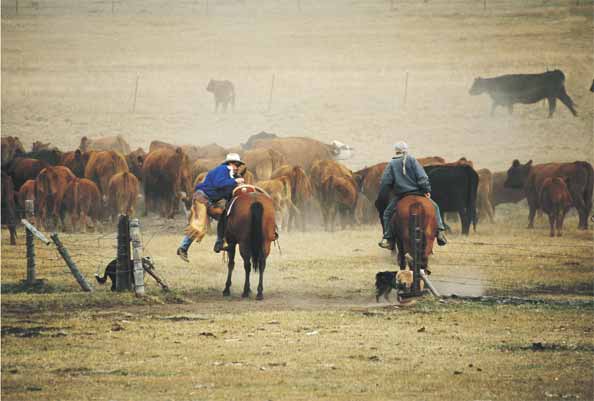
Gerda Hyde (right) and son, John, gather the herd with the help of their dogs. |
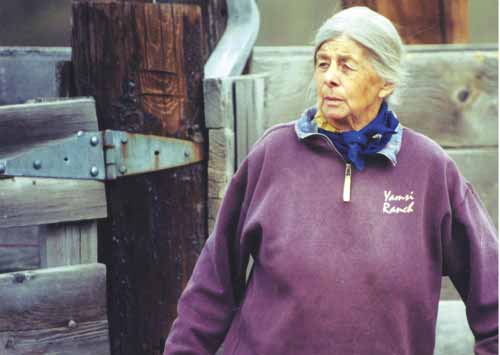
Gerda and John are innovative cattle ranchers. They are members of Oregon Country Beef, a group of 40 ranchers dedicated to a program of national land stewardship, producing natural, chemical-free beef. The Hydes are practitioners of many of wildlife biologist Allan Savory’s grazing methods, including grazing rotation, which allows grasslands rest and rejuvenation.
“Savory found out that the more they got rid of the big animals, the more land turned to desert,” explains Gerda. “Herding is important. Hooves break up manure and soil which allows aeration and permeation of moisture and nutrients.” She also believes that healthy cattle deter predators. “Cattle should be gentle. It’s important to breed good mothers and cull out the wild cattle. Coyotes will not attack good, protective mothers.”
The Hydes use electric fences to keep cattle off riverbeds. “Every once in a while though,” Gerda says, “you still need to graze in order to reduce a mat of riverbank grass.”
Gerda and John pretty much see eye-to-eye on ranching practices.
“My differences with Ma depend on the day and how much sleep she’s had,” deadpans John.
“Well, my differences depend on whether he’s wearing dark glasses or not,” retorts Gerda. “If the next generation wants to hold onto the ranch, they need to have new ideas and be innovative.” The Hydes graze and then rest the land 45 days per unit. They’ve developed new wetlands on their property. “Mom alone has planted thousands of trees,” says John. “She’s a tree-planting fool.”
“The cattle industry has always had tunnel vision,” says Gerda. “If we’re not learning, we’re dying, so we must keep learning.” She suggests that members of the cattle community research Bud Williams’ innovative cattle handling practices along with Savory’s and others’ ideas. “A good start would be by subscribing to Holistic Resource Management by calling 505-842-5252.”
Gerda Hyde is obviously a lady who knows the value of work, family and friends. She honors both the private and public life. Once she served as president of the National Cattlewomen’s Association. She is an active patron of the arts, host to many cookoué functions, and an avid supporter of her grandchildren’s activities. Operation Stronghold, which the Hydes established, is a voluntary, nonprofit organization that encourages the development of wildlife potential on private lands.
According to Gerda’s husband, Dayton, “It is led by the private sector, which helps farmers, ranchers, timber producers, and other landowners create vital reservoirs of wildlife and plants on their own land.” There are 300 active members worldwide. The Hydes still sell Operation Stronghold signs ($7 each) but they are not nearly as active with the program as they used to be. “We’ve let it fizzle,” Gerda says, “because we’ve just not had the time to tend to it properly.”
Time clearly doesn’t hang heavy on Gerda Hyde’s hands; she always seems to be busy. But when she winds down, you’re most likely to find her in the spacious ranch house living room—built with native rock and timbers by Buck Williams in 1928. She’ll be playing classical music on the old Victrola or reading a good book. Among those are the ones her husband wrote about life at the Yamsi Ranch. Dayton O. Hyde now lives in Rapid City, S.D., where he manages the Wildhorse Sanctuary, which he founded after he left “the home of the north wind.” Gerda’s still there, though, with no plans to leave anytime soon.
“I’ve had a great life on this ranch,” she says, her green-gray eyes twinkling, “though it has had its ups and downs. Sort of like what Churchill said about brandy: ‘In the end, I got more out of it than it got out of me.’”
Larry Turner, a regular contributor to RANGE, lives in Malin, Ore.
|
|
|
|
© 1998-2005 RANGE magazine. All rights reserved. | For reprints, permissions or general questions, contact |
|
Brought to you by Dolphin Enterprises |